Table of Contents
How to Rank in AI Overviews: A Practical Optimization Guide
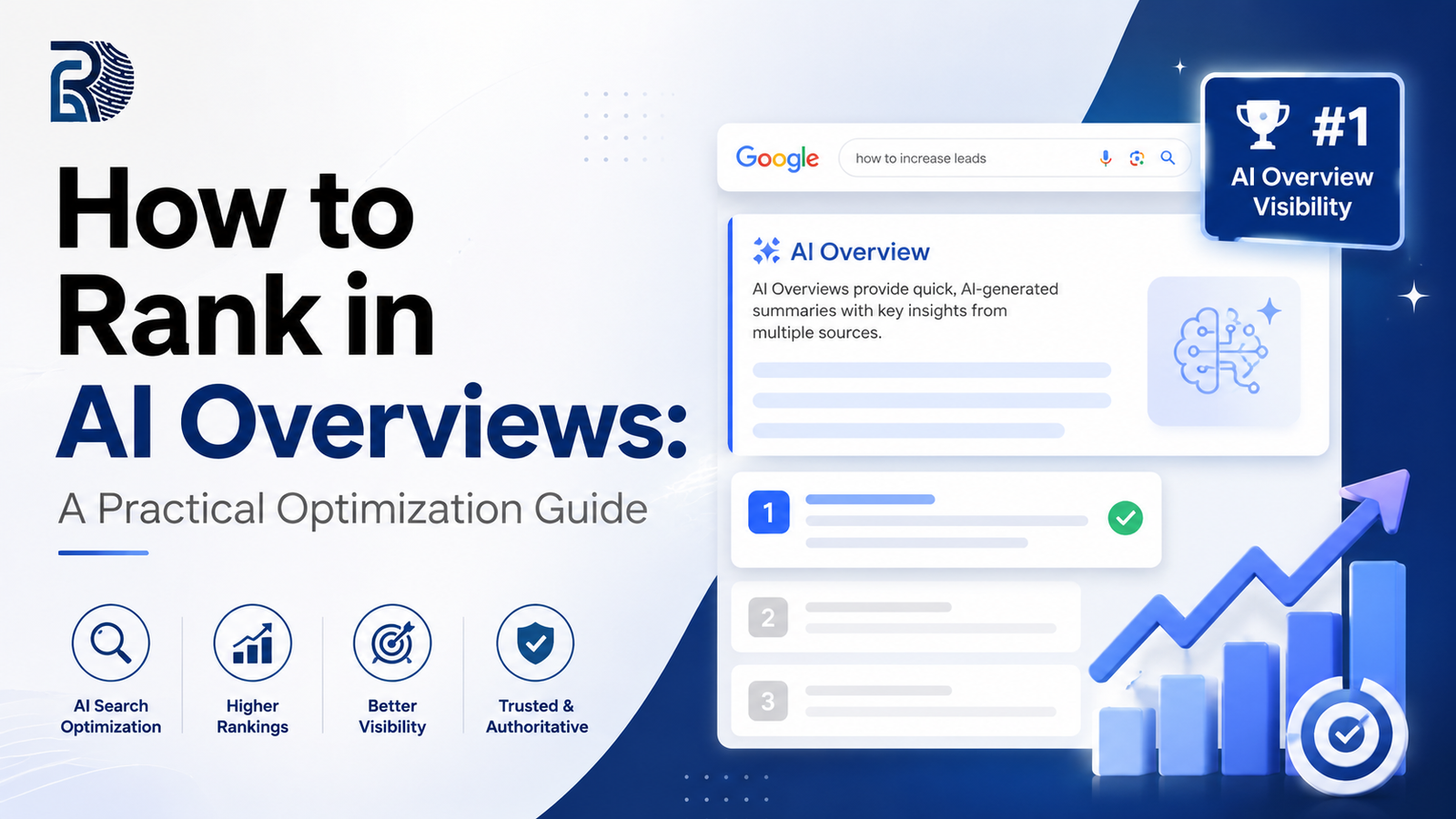
Google AI Overviews have slowly moved where the search focus has been. This block of text generated by AI, placed just above organic results, isn't disappearing, and for many SEO experts, the issue isn't whether I should care about this. Rather, how do I get cited there? This guide explains how to rank in Google AI Overviews. With clear proven strategies that have been tested, regardless of whether you're a content marketing professional, SEO consultant, or business proprietor, you'll leave with a strategy you can implement today.
What Are AI Overviews and Why Do They Matter for SEO?
AI Overviews are Google's AI-generated overviews that are displayed at the top of the results of certain searches. They gather information from a variety of websites and combine it into an easy response, using a list of citation links that visitors can browse.
The SEO implications are significant. Research shows that click-through rates for conventional organic search results drop dramatically if the AI Overview appears on the webpage. Getting cited in AI-generated answers is no longer just an extra benefit; it's essential to maintaining rankings. If your website's content doesn't appear included in the summary, it will be lost prior to users scrolling through natural results.
This shift changes the meaning of the ranking. An article in an AI Overview may sit in place four in organic search results, yet get more attention on the page at position one. This is an entirely different situation that demands reconsideration of how you judge SEO the success of your SEO.
How AI Overviews Choose Content Sources
Learning the way AI Overviews choose sources is the initial step towards being cited. Google doesn't disclose its complete selection algorithm and its selection criteria, but the consistent patterns across its data and its own guidelines indicate a distinct pattern.
Relevance to the specific query
Google's AI splits complicated questions into smaller ones and then provides the solutions for every one. Your website's content needs to address more than simply the broad subject, but rather the angle your person is seeking information on.
Demonstrated topical authority
Sites that regularly cover an area with interconnected content over many related pages show up in AI overviews more frequently than websites that only have articles.
E-E-A-T signals
Experience, expertise, authoritativeness, and Trustworthiness serve as Trust filters. Experience, author credentials, firsthand knowledge, and cited information are all factors in determining the degree to which Google will accept your information into an artificial response.
Search intent alignment
AI Overviews tend to be centered on informational questions. Written content that is designed to answer direct questions works better than content that is written mostly for conversion.
Freshness
AI Overviews prefer the latest content, especially for subjects in which information changes. Deprecated content should be fixed.
Practical Ways to Rank in AI Overviews
Create Content That Answers Questions Directly
Getting cited in AI-generated answers is a requirement for writing in the style that AI Overviews employ. This means concise, clear responses to the very top, written in simple language. If someone is asking why X happens, respond concisely in the first couple of paragraphs, and then add additional details. Don't hide your answer in lengthy introductions.
Build Strong Topical Authority
A simple optimized webpage does not always suffice. Google assesses the site's coverage of a topic as an entire. Find the most important issues in your field and create a cluster of content that tackles them from a variety of viewpoints. If Google finds that your website is truly covering a topic with depth, the probability of it being mentioned in relevant searches increases substantially.
Improve E-E-A-T Signals
Include real bios of authors with the relevant qualifications. Include a link to your original research that your team has conducted. Incorporate case studies, experts' quotations, or observations of your own experiences. If you believe that a person who has real expertise wrote the content you are presenting, it will be obvious to users and Google's system.
Use Structured Data and Schema Markup
Schema markup is a way to help Google better understand your content. The FAQ schema, the HowTo schema, and the Article schema define the content's structure and intention of your contents. If Google's AI determines the right response to a certain sub-question, the content that is well-structured gets processed more precisely and is easier to match.
Optimize for Search Intent, Not Just Keywords
Ranking factors for AI Overviews are firmly tied to the intent. The most important thing to consider is the why and how types. Searches that start with " why trigger AI Overviews with unusually high frequency, and so do more lengthy questions that are conversational and comprise seven or more phrases. Be less concerned about the density of keywords and think more about the quality of your content and whether it meets the needs of a person who wants to know.
Create Original Insights and Data
AI Overviews are prone to referring to sites that have something distinctive. If your content is a repeat of what others have already stated, there's no compelling argument to Google to favor the content. Make use of original research, unique research, or documented instances to separate your website from the sea of common material on the same subject.
Strengthen Internal Linking and Build Backlinks
The well-linked website gives the crawlers of Google a detailed outline of how your website's information is linked to other sites. The descriptive anchor text boosts your site's credibility and demonstrates how your web pages connect. This is paired with backlinks from trusted media. Pages that have earned links from trusted external sources have greater trust, and this directly impacts AI Overview citation potential.
Common Mistakes That Prevent AI Overview Visibility
Thin content that covers a topic at the surface level
If you answer an inquiry in just two paragraphs with no real dimension, it's unlikely to get a re-entry into an AI answer.
Generic AI-generated content with no original perspective
Google's AI systems are getting better at spotting content that provides little or no perspective. Making your blog appear more AI-generated filler can lead to it being disregarded by AI Overviews in totality.
Poor site structure and weak internal linking
If your site is not organized in a clear, topical manner, Google may struggle to determine your website's authoritative source on the subject.
Ignoring search intent
Making a transactional piece of content only to hope it is included within AI Overviews for informational queries can be an error. The intention must be compatible.
Weak or absent authority signals
Lack of author details, no reference to the author, or no external validation is a challenge for Google to trust the information enough to allow it to be cited.
AI Overview Optimization Checklist
This checklist will help you audit your content before deciding to publish or update:
- Does this page address the specific question in detail or early?
- Does the author have the appropriate qualifications or expertise?
- Are the contents part of the larger topic group? Is it not an individual page?
- Do you have new data, insights, or case research?
- Does schema markup get applied when it is appropriate?
- Does the page appear to be internally linked to the same web pages?
- Was the content reviewed or updated in the past twelve months?
- Are backlinks or mentions coming from reliable external sources linked to this site?
- Does the text match the purpose of the information in the query?
The Future of SEO in an AI Search World
The course of Google's AI search development is evident, and answers are turning into the main destination, not only an avenue to get clicks. However, this doesn't mean the organic search engine is dying. However, content quality requirements are increasing. Content that is generic and undifferentiated can't keep up. Companies with authentic credibility, proven expertise, and a history of relevant information will be mentioned and regarded as trustworthy.
The best option for many firms is to put their money extensively in fewer areas of fewer subjects instead of spreading it across a multitude of subjects. The depth of a topic is superior to the breadth of an AI-driven search engine, and this is getting more and more commonplace over time.
Conclusion
The ability to be cited on AI Overviews is not a different strategy from an effective SEO strategy that is effective. This is the way that an effective SEO is becoming content that addresses actual questions with real expertise and is organized into websites that are backed by clear, authoritative topical knowledge. If you've written to be written for search engines, rather than people searching, now is the time to switch that.
We at Rapid Digital Growth, this is precisely the kind of work that we can help our clients create, resulting in the type of authority that generates the prominence where today's search focus exists. Optimization is a real possibility that begins with a solid foundation.