

No headings found
India crossed 900 million internet users in 2026, and digital ad spend is projected to exceed Rs 75,000 crore by year-end. Those numbers sound impressive, but they also describe the competitive pressure every Indian business now operates under. Standing out in this environment is no longer about simply being present online. It is about how intelligently you use the tools available to reach, engage, and convert a market that is fragmented across languages, devices, platforms, and purchase stages.
AI has moved from an aspirational concept to a practical necessity within this landscape. For businesses evaluating how their digital marketing for different industries should evolve, or for any team working with a digital marketing agency in India, these seven strategies reflect where the meaningful growth is actually happening in 2026.
The search behaviour of Indian consumers has changed structurally. AI-generated answers from Google AI Overviews, Perplexity, and similar platforms are intercepting queries before the user ever reaches a blue link. This is not a future concern. It is the current reality for high-intent informational queries across categories from healthcare to finance to education to consumer electronics.
Only 23 percent of Indian businesses have fully integrated AI into their operations, according to EY-CII research, and even fewer have adapted their SEO strategy to account for this shift. The practical implication: most of your competitors are still optimising for a search environment that has already changed.
Answer Engine Optimisation means structuring content to directly answer the specific questions your audience is asking, using clear headings, concise factual statements, and entity-based content architecture that AI systems can parse and cite. For digital marketing for different industries, the specific questions vary, but the structural approach is consistent.
India’s diversity is a marketing challenge that most brands have historically managed by broadcasting a single message across a wide audience. AI changes the economics of personalisation in a way that makes segment-specific communication viable even for mid-sized businesses.
AI-powered tools can now analyse purchase history, browsing behaviour, geographic signals, and content interaction patterns in real time and trigger personalised communication sequences without manual intervention. A D2C brand reaching customers across Tamil Nadu, Gujarat, and West Bengal can serve contextually different messaging in each market, matched to local language preferences, seasonal moments, and product relevance, without maintaining three separate campaign teams.
Seventy percent of Indian businesses desire generative AI for automation, according to EY-CII data. The businesses already executing on personalisation at this level are building a customer experience advantage that generic broadcast competitors cannot match.
WhatsApp has over 500 million users in India and is the primary communication channel for a significant proportion of business enquiries. AI-powered chatbots and conversational interfaces deployed on WhatsApp Business API, website chat, and app-based support are addressing the gap between when customers want to engage and when human support is available.
For industries including healthcare, real estate, education, and financial services, where the sales cycle involves multiple touchpoints and information exchange before conversion, conversational AI qualifies leads, answers frequently raised questions, books appointments, and captures contact information around the clock.
The specific application of this strategy varies considerably across digital marketing for different industries. A healthcare clinic uses it differently from an EdTech platform, but the underlying value is consistent: reducing the gap between customer intent and business response.
GEO, Generative Engine Optimisation, addresses how a brand’s content and reputation influence the outputs of AI systems like ChatGPT, Gemini, and Perplexity when users ask those systems for recommendations, comparisons, or solutions. When someone asks Gemini which accounting software companies in India are reliable, or which D2C skincare brands are worth trying, the system draws on indexed content, brand mentions, and information patterns from across the web.
LLM searches and GEO are becoming core to brand discovery in 2026. Brands that consistently publish authoritative, well-structured content and earn mentions in credible external publications will appear more frequently in AI-generated recommendations, while brands that exist only in paid ad placements will be invisible in this growing discovery channel.
For any business working with a digital marketing agency in India on a content strategy, adding a GEO layer to the existing SEO plan is the highest-leverage content investment available right now.
Quick commerce and retail media have created an advertising environment in India that did not meaningfully exist two years ago. Platforms like Blinkit, Zepto, and Swiggy Instamart are generating combined advertising revenues approaching Rs 4,900 crore in 2026. The reason brands are shifting budgets here is structural: these platforms collapse the funnel from ad exposure to completed purchase into a single session.
For FMCG brands, D2C companies, and consumer goods businesses, AI-powered targeting on commerce media means ads can be served based on purchase history, location proximity to dark stores, time-of-day intent signals, and category affinity, rather than broad demographic targeting. The result is spending that reaches buyers closer to the moment of decision than any other digital channel currently available.
Rapid Digital Growth has been helping Indian brands integrate commerce media into broader digital strategy, treating it as a performance layer that complements rather than replaces brand-building activity on social and search.
India’s next 200 million internet users are coming online in regional languages. This is not a niche segment. It is the primary growth opportunity for digital marketing in India over the next three to five years, and the businesses that build vernacular content capacity now are positioning themselves ahead of the competition that will discover this need later.
AI has significantly reduced the cost and complexity of producing high-quality vernacular content. Generative AI tools now produce usable draft content in Hindi, Tamil, Kannada, Bengali, Telugu, and Marathi, which human editors can refine rather than translate from scratch. This makes vernacular content strategy economically viable for businesses that previously could not justify the resource investment.
The search behaviour of vernacular users differs from English-first users in meaningful ways, including different query structures, different content format preferences, and different platform usage patterns. Digital marketing for different industries in vernacular markets requires content strategies that account for these differences rather than simply translating existing English content.
Seventy-seven percent of Indian businesses cite difficulty demonstrating ROI from AI, and 60 percent cite data quality issues as a primary scaling challenge. These two problems are connected. AI marketing tools are only as useful as the data flowing into them.
Businesses that have been running digital marketing for several years often have fragmented data: conversion tracking set up inconsistently, analytics properties that have not been audited since their initial configuration, CRM data that has not been synchronized with digital campaign data, and attribution models that do not reflect actual purchase journeys.
Before scaling any of the six strategies above with AI-powered tools, a data quality audit is the foundational investment that determines how accurately those tools can learn, optimise, and report. Setting up Google Analytics 4 correctly and reviewing it weekly, as one practical starting point, positions a business to make decisions based on real engagement signals rather than directional estimates.
Rapid Digital Growth approaches every client engagement with this sequencing in mind: clean data first, then AI-powered execution, because the ROI demonstration problem that 77 percent of Indian businesses struggle with is almost always a data problem rather than a strategy problem.
The seven strategies above represent where Indian digital marketing is actually moving in 2026, grounded in what is working across industries rather than what sounds impressive in a conference presentation. AI-powered personalisation, GEO, commerce media, vernacular content, conversational interfaces, and answer-focused content architecture are not independent tactics. They compound when implemented together as a unified digital strategy.
India’s digital economy is projected to exceed $1 trillion by 2030, and the brands building their AI-powered marketing capabilities now are establishing the advantages that will define category leadership as that growth arrives.
Rapid Digital Growth works with Indian businesses across sectors to design and implement digital strategies that account for where the market is in 2026, not where it was in 2022. For any business evaluating whether its current digital marketing approach is keeping pace with how Indian consumers are now discovering, researching, and purchasing, the starting point is an honest audit of the current strategy against these seven areas.
 AI
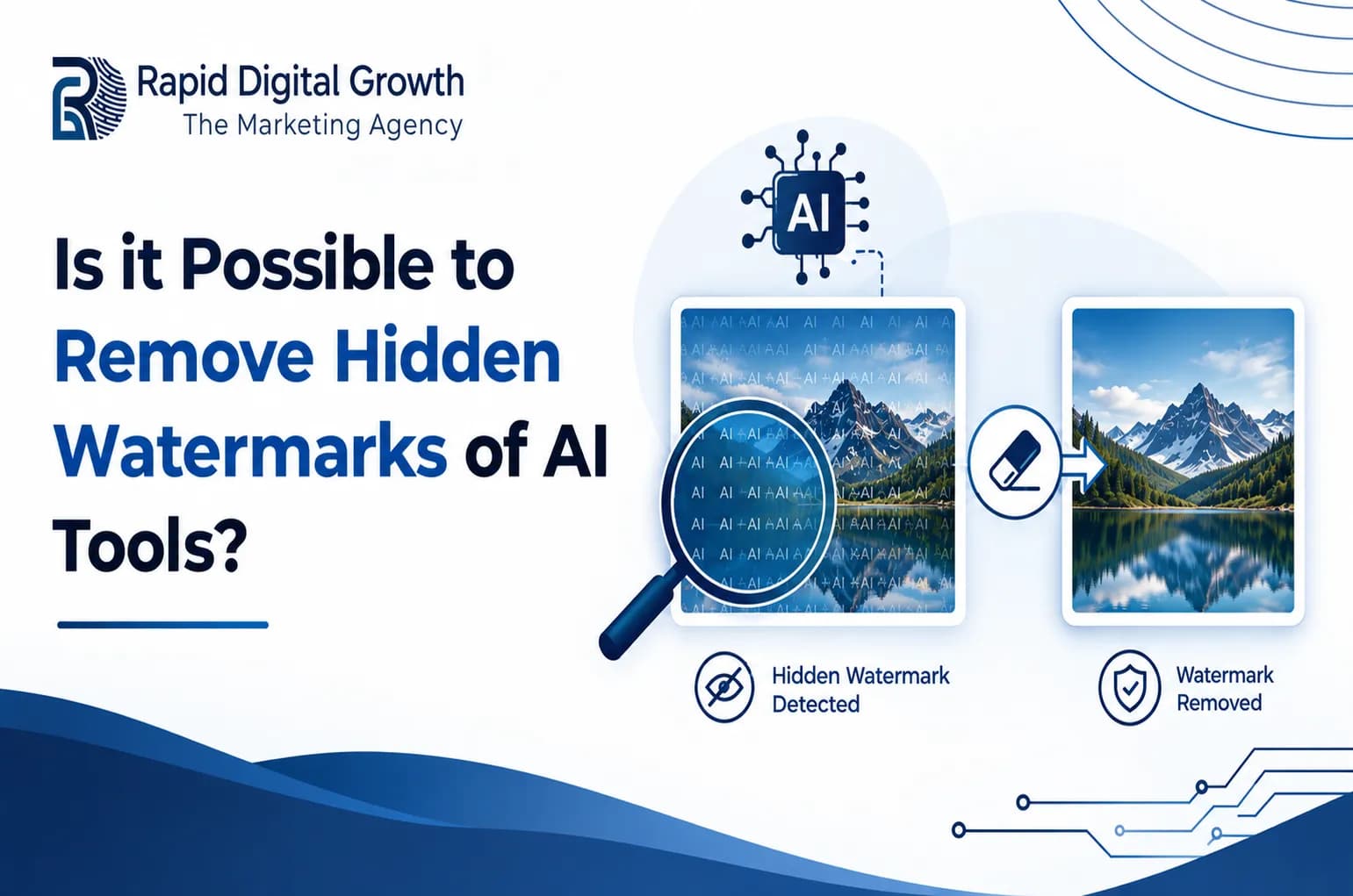
AI watermarks are built into more content than most people realize. Here's how they actually work, why removal is harder than it sounds, and what to know.
Read More