Table of Contents
AI and Automation Begin Reshaping CRM Development and Mobile App Experiences
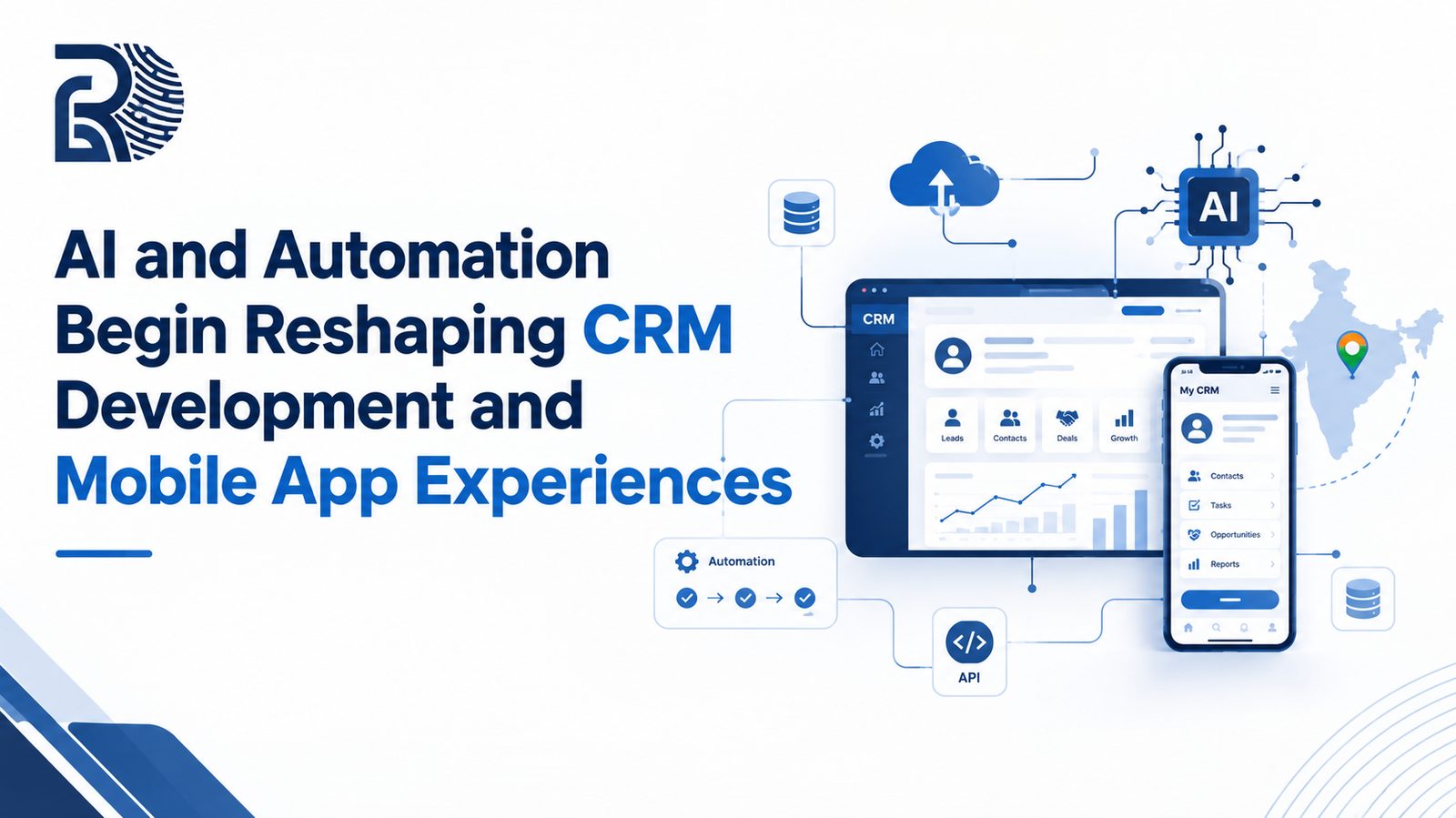
Not long ago, a CRM was where your sales team logged calls after the fact, and a mobile app was a separate project entirely, built to give customers a convenient window into your business. Those two worlds have been quietly merging for years, but 2026 marks the point where the merger became impossible to ignore. CRM platforms are increasingly making decisions on their own, and mobile apps are shifting from passive tools people check to active systems that anticipate what a user needs before they ask for it.
This shift matters for a very practical reason: businesses investing in CRM Development and Mobile App Development today are no longer building two separate systems that happen to share data. They're building one connected experience where automation handles the repetitive work, and AI increasingly makes judgment calls that used to require a human in the loop. At Rapid Digital Growth, we're seeing this shift show up directly in what clients ask for, and understanding where it's headed is genuinely useful whether you're planning a new build or reassessing an existing system.
From Predictive Analytics to Systems That Actually Act
For years, "AI in CRM" mostly meant predictive scoring, flagging which leads were likely to convert, forecasting churn risk, and surfacing patterns a sales rep might have missed. That's still valuable, but it's no longer where the real shift is happening. The defining change in 2026 is the move toward agentic AI within CRM systems, platforms that don't just recommend an action but actually execute it, following up with a lead, updating a record, triggering a workflow, or escalating an issue, without waiting for a person to click approve on every single step.
This matters enormously for how CRM development is approached from a technical standpoint. Building a system that can act autonomously requires far more careful attention to governance and guardrails than building one that simply displays recommendations. Teams now need to define clear boundaries for what an AI agent can do independently versus what still requires human sign-off, particularly around anything touching compliance, pricing, or customer-facing commitments a business needs to stand behind.
Why Mobile Apps Are Becoming the Front Line for This Shift
Mobile app development is undergoing a genuinely parallel transformation, and the numbers behind it are striking. Industry analysis projects that by the end of 2026, roughly 40 percent of enterprise mobile applications will include task-specific AI agents, up from around 5 percent just a year earlier. That's nearly an eightfold increase in the span of twelve months, reflecting how quickly this capability has moved from experimental to expected.
What this looks like in practice varies by industry, but the pattern is consistent: apps that used to wait passively for user input are increasingly working in the background to get things done. A logistics app might automatically reroute a delayed driver and notify the warehouse without anyone opening the app to trigger it. A field service app might capture a technician's on-site notes and immediately update a customer record and schedule a follow-up, all without a manual data entry step afterward.
This is precisely where mobile app development and CRM development have stopped being separate disciplines. An app that can act autonomously on a user's behalf usually needs to be pulling from and writing back to a CRM in real time, which means the two systems increasingly need to be architected together from the start instead of integrated as an afterthought.
The Rise of Mobile-First, Field-Ready CRM
Mobile CRM used to mean a scaled-down version of the desktop experience, with enough functionality to check a record or update a note while away from a desk. That's changed substantially. Mobile CRM in 2026 increasingly functions as a genuinely field-ready tool, offering real-time guidance and proactive suggestions to someone actively working a job rather than just giving them remote access to the same static data.
A few specific capabilities are driving this shift:
Offline autonomy with automatic sync. Field teams working in areas with unreliable connectivity can capture data and trigger workflows locally, with everything syncing back to the core system automatically once a connection is available, instead of losing work or waiting until they're back at a desk.
Proactive, in-context suggestions. In place of requiring a user to search for next steps, mobile CRM tools increasingly surface relevant actions directly: a suggested follow-up, a service reminder, an upsell opportunity, based on the live context of what the user is currently doing.
On-device processing for speed and privacy. Edge AI, where certain processing happens directly on the device rather than requiring a round trip to a central server, is becoming more common specifically because it reduces latency and keeps sensitive data from needing to leave the device unnecessarily.
What This Means for Businesses Planning a New Build
If you're approaching CRM Development or Mobile App Development for your business right now, a few strategic considerations are worth factoring in early, before development starts,s rather than as a retrofit later:
- Plan for AI-driven automation from the architecture stage, not as an add-on. Systems built with autonomous actions in mind from day one integrate far more cleanly than ones where automation gets bolted onto an existing structure that wasn't designed to support it.
- Define governance boundaries before deployment, not after an incident. Decide explicitly what an AI agent is allowed to do independently and what requires human review, particularly for anything customer-facing or compliance-sensitive, in place of discovering the gap after something goes wrong.
- Treat your CRM and mobile app as one connected system, not two integrated ones. The businesses getting the most value from this shift are designing data flow and automation logic across both systems together, instead of building each in isolation and connecting them afterward.
- Prioritize clean, unified data before adding intelligence on top of it. AI-driven personalization and automation are only as good as the data feeding them. Fragmented customer data across disconnected systems undermines even the most sophisticated automation layered on top of it.
- Choose a development partner who understands both domains, not just one. A team strong in mobile app development but unfamiliar with CRM architecture, or vice versa, often produces a system where the two components don't communicate as fluidly as they should.
Common Mistakes Businesses Make During This Transition
- Adding AI features for the sake of having them, without a clear operational reason tied to what actually improves the customer or team experience.
- Underestimating the governance work required once a system starts taking autonomous action, assuming the same oversight approach used for simple automation still applies.
- Treating mobile and CRM development as sequential projects, rather than a connected build, frequently results in a mobile app that feels disconnected from the CRM data it's supposed to be working with.
- Ignoring offline and edge scenarios for field teams, building an experience that assumes constant connectivity when real-world usage frequently doesn't match that assumption.
Key Takeaways
CRM Development and Mobile App Development are converging faster than most businesses have fully adjusted to, driven by AI systems that increasingly act just to advise, and by mobile experiences that anticipate the need for a place of waiting to be asked. The businesses gaining a genuine edge from this shift aren't necessarily the ones adopting AI fastest; they're the ones planning for autonomous, connected systems from the architecture stage rather than retrofitting automation onto structures that weren't built for it.
If you're evaluating how to approach your next CRM or mobile app build with this shift in mind, that's exactly the kind of planning conversation worth having before development starts. Rapid Digital Growth works with businesses to architect CRM and mobile experiences as one connected system from the outset, so automation and AI capabilities integrate cleanly instead of being added on after the fact.